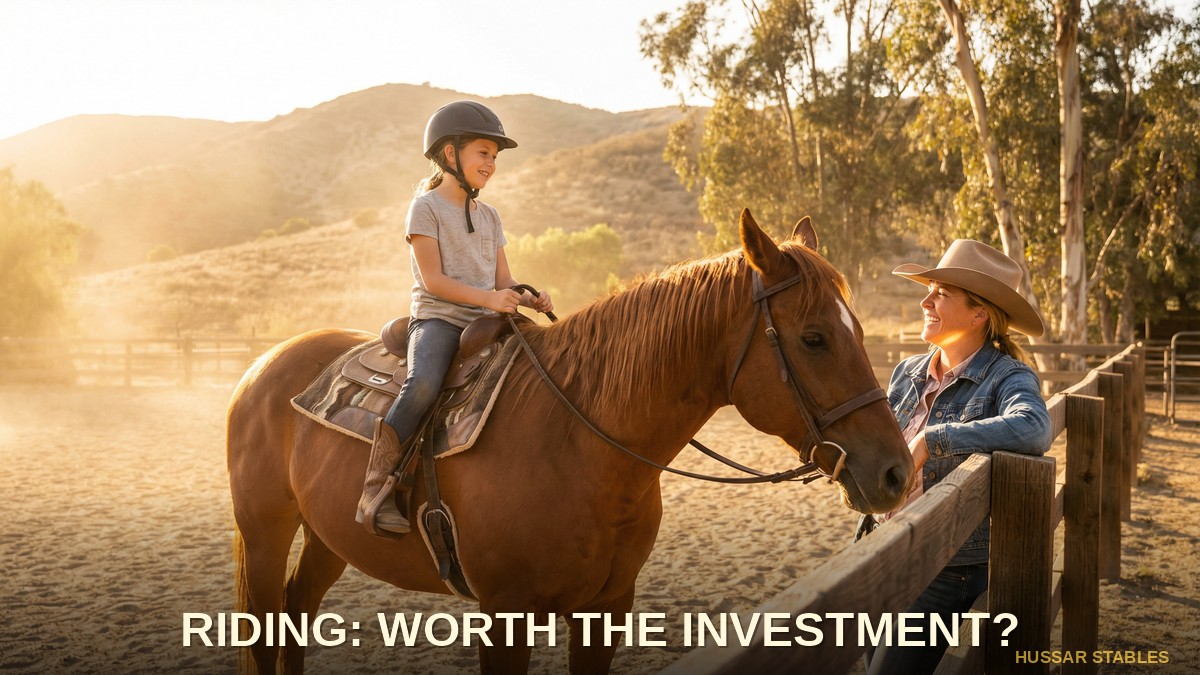
Before you commit to riding lessons, here is the honest truth about what you get for your money — the benefits, the hidden costs, and how to know if it is the right fit for your child.
Yes — for the right child in the right program, horseback riding is absolutely worth the investment. It builds confidence, physical fitness, emotional regulation, and responsibility in ways few other sports can match. The key is choosing a structured program with a defined curriculum, not a drop-in barn.
Every parent who walks through our gate at Hussar Stables asks some version of the same question: "Is this actually worth it?"
It is a fair question. Riding lessons are not cheap. The time commitment is real. And unlike soccer or gymnastics, most parents did not grow up riding, so they have no frame of reference for what good instruction looks like or what reasonable progress feels like.
This guide is our honest attempt to answer that question — including the parts that most barns will not tell you.
The Real Benefits of Horseback Riding
Let's start with what you actually get.
Confidence that transfers. Learning to communicate with and direct a 1,000-pound animal requires a child to find their voice — to be assertive without being aggressive, calm without being passive. This is not a metaphor. The skills children develop in the saddle show up in the classroom, on sports teams, and in social situations. We hear it from parents constantly: "She is a completely different kid since she started riding."
Physical development that is hard to replicate. Riding is a full-body workout that disguises itself as play. The core strength required to maintain a balanced seat, the fine motor coordination needed to apply subtle leg aids, the proprioceptive awareness developed through hours of posting trot — these are physical skills that complement every other sport your child plays.
Emotional regulation under pressure. Horses are honest. They respond to anxiety, frustration, and aggression immediately and without judgment. Children who ride learn, through direct experience, that emotional regulation is not just a nice idea — it is a practical skill that produces better results. A tense rider produces a tense horse. A calm rider produces a calm horse. This feedback loop is one of the most powerful teaching tools in any sport.
Responsibility and empathy. The best riding programs teach more than how to steer. They teach horsemanship — how to groom, tack up, read body language, and care for the animal. Children who learn horsemanship develop a deep sense of responsibility and empathy that extends far beyond the barn.
The Hidden Costs (And How to Budget for Them)
Here is the part most barns skip over.
Equipment: Budget $150-400 for a certified helmet, boots, and riding pants. This is a one-time cost that lasts years.
Show fees: If your child progresses to competing, entry fees run $50-200 per show. Shows are optional at Hussar Stables — we never pressure families to compete before they are ready.
Transportation: If you are driving from Santa Clarita or Valencia, factor in gas and time. Many families find the drive worthwhile; others prefer a closer option.
Tack and gear: As your child advances, they may want their own equipment. This is a future cost, not an immediate one.
The Honest Answer: It Depends on the Program
Here is the truth that most barns will not say out loud: the quality of the program matters more than anything else.
A child in a drop-in barn with inconsistent horses and rotating instructors will spend two years "learning to ride" and still be nervous on a horse. A child in a structured program with a defined curriculum, consistent horses, and qualified instructors will be cantering confidently within six months.
The cost of a structured program is higher. The value is dramatically higher.
At Hussar Stables, we built our program around this principle. Every member follows a defined curriculum. Every lesson builds on the last. Every horse is selected for temperament, training, and suitability for the level of rider they carry. We track progress, celebrate milestones, and communicate with parents at every step.
How to Know if It Is the Right Fit
Before committing to any program, we recommend:
1. Book an Intro Lesson. See the facility, meet the horses, and watch your child interact with the environment. Your gut will tell you a lot.
2. Ask about the curriculum. A good program can show you exactly what your child will learn and in what order.
3. Ask about instructor credentials. Look for USDF, BHS, or Working Equitation certification.
4. Watch a lesson in progress. Are the horses calm? Are the kids engaged? Is the instructor attentive?
If the answer to all four is yes, you have found a program worth investing in.
Ready to find out if Hussar Stables is the right fit? Book your Intro Lesson today — no commitment required.
- Riding builds confidence, empathy, and leadership skills that transfer directly to school and life
- Physical benefits include core strength, balance, coordination, and cardiovascular fitness
- The 'hidden costs' (equipment, shows, gas) are real but manageable with a clear budget
- The right program makes all the difference — a structured curriculum produces riders; drop-in lessons produce passengers
- Most families who commit to a structured program for 6+ months report it is one of the best decisions they made
Have a question?
Text us — we reply fast.
(661) 227-3214 · Hussar Stables, Palmdale CA
Ready to Experience This in Person?
Book a private Intro Lesson at Hussar Stables and discover why families from Palmdale, Lancaster, and Santa Clarita choose our members-only riding club.
Book Intro Lesson