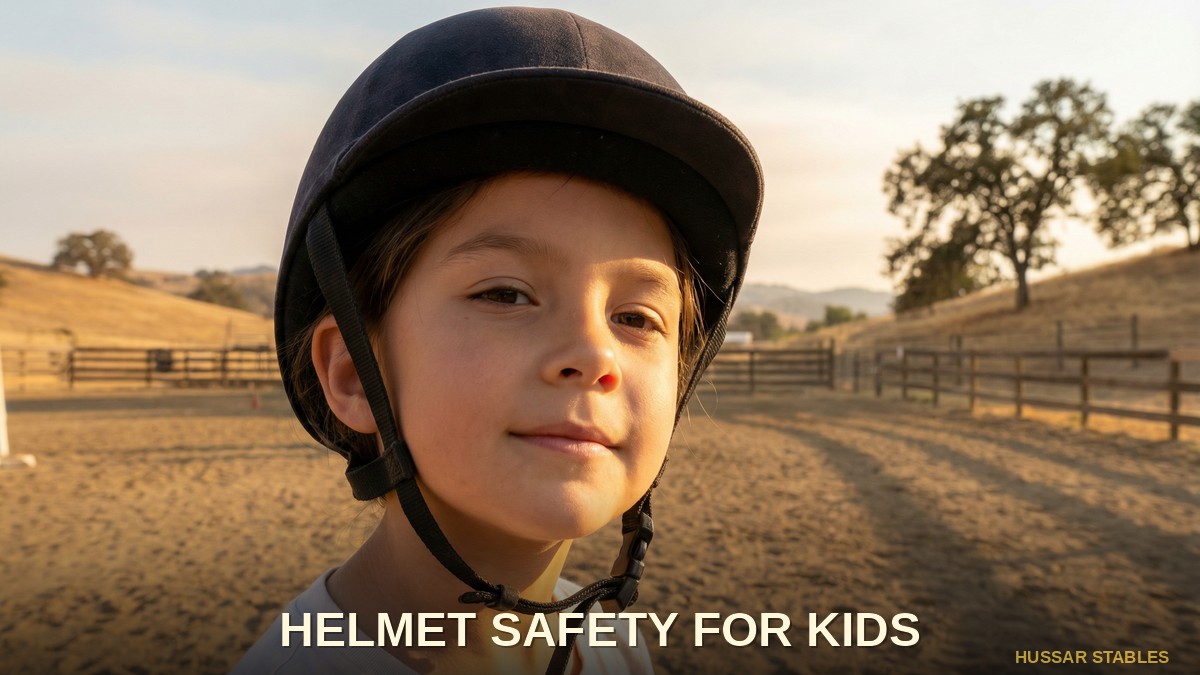
Ensure your child's safety with our comprehensive guide to riding helmets. Learn about ASTM/SEI certification, proper fitting techniques, and when to replace helmets for optimal protection in equestrian activities.
The most important things to know: always wear an ASTM-certified equestrian helmet (not a bicycle helmet), ride horses appropriate for your skill level, and choose a program with qualified instructors and a defined safety protocol. At Hussar Stables, safety is built into every aspect of our program.
At Hussar Stables, nestled in the heart of Palmdale, CA, we understand that the safety of our riders, especially our younger equestrians, is paramount. Horsemanship is a rewarding discipline that teaches grace, strength, and connection, but like any sport involving animals, it carries inherent risks. The single most crucial piece of safety equipment for any rider, regardless of age or experience, is a properly fitted and certified riding helmet. This guide is designed to help parents in Palmdale, Lancaster, Santa Clarita, and throughout the Antelope Valley understand the critical aspects of equestrian helmet safety.
Why a Specialized Riding Helmet is Non-Negotiable
It\'s a common misconception that any helmet will suffice for riding. Many parents, with the best intentions, might consider a bicycle helmet or a multi-sport helmet as an adequate substitute. However, this is a dangerous oversight. Equestrian helmets are specifically designed to protect against the unique impacts associated with riding, which differ significantly from those encountered in cycling or skateboarding.
The Dangers of Using Non-Equestrian Helmets
Bicycle helmets, for instance, are engineered to protect against a single, direct impact, typically a fall onto a hard surface from a relatively low height. They are designed to crush and dissipate energy upon impact, often rendering them unusable after just one incident. Equestrian accidents, however, can involve a wider range of impact types: falls from a greater height, impacts with hooves, or being crushed against a solid object. These scenarios demand a helmet with multi-directional impact protection and greater penetration resistance.
Understanding ASTM/SEI Certification
When selecting a riding helmet, the most important factor to look for is its certification. In North America, the ASTM F1163 standard, certified by the Safety Equipment Institute (SEI), is the gold standard. This certification means the helmet has undergone rigorous testing to ensure it meets specific safety criteria for equestrian use.
What Does ASTM/SEI Certification Mean?
An ASTM/SEI certified helmet has been tested for:
Impact Absorption:* The helmet\'s ability to absorb and dissipate energy from a fall, reducing the force transmitted to the rider\'s head.
Penetration Resistance:* Protection against sharp objects, such as a horse\'s hoof or a tree branch, piercing the helmet.
Retention System Strength:* The chin strap and harness\'s ability to keep the helmet securely on the rider\'s head during an impact.
Peripheral Vision:* Ensuring the helmet does not obstruct the rider\'s field of vision.
Always look for the ASTM/SEI sticker or label inside the helmet. Without this certification, you cannot be assured that the helmet provides adequate protection for equestrian activities.
How to Fit a Riding Helmet Correctly
A helmet, no matter how certified, is only effective if it fits correctly. A poorly fitted helmet can shift during a fall, leaving parts of the head exposed, or even come off entirely. Proper fitting is a crucial step in ensuring maximum protection.
Step-by-Step Fitting Guide
1. Measure the Head: Use a flexible tape measure to measure the circumference of the rider\'s head, just above the eyebrows and ears. This will give you a starting point for helmet size.
2. Try On: The helmet should sit level on the head, covering the forehead without tilting back. The brim should be about two fingers\' width above the eyebrows.
3. Check for Movement: With the chin strap unfastened, the helmet should feel snug. When the rider shakes their head gently from side to side and front to back, the helmet should not shift significantly. It should feel like an extension of the head, not a loose accessory.
4. Adjust the Harness: Fasten the chin strap. The straps should form a \'V\' shape around the ears, and the buckle should be centered under the chin. The strap should be snug enough that only one finger can fit comfortably between the strap and the chin.
5. **Perform the \
- Always wear an ASTM/SEI-certified equestrian helmet — a bicycle helmet is not acceptable
- Boots with a 1-inch heel prevent the foot from sliding through the stirrup
- A calm, experienced lesson horse is the single most important safety factor
- Small class sizes allow instructors to monitor and correct safety issues in real time
- Learning to read horse body language dramatically reduces risk for every rider
Have a question?
Text us — we reply fast.
(661) 227-3214 · Hussar Stables, Palmdale CA
Ready to Experience This in Person?
Book a private Intro Lesson at Hussar Stables and discover why families from Palmdale, Lancaster, and Santa Clarita choose our members-only riding club.
Book Intro Lesson