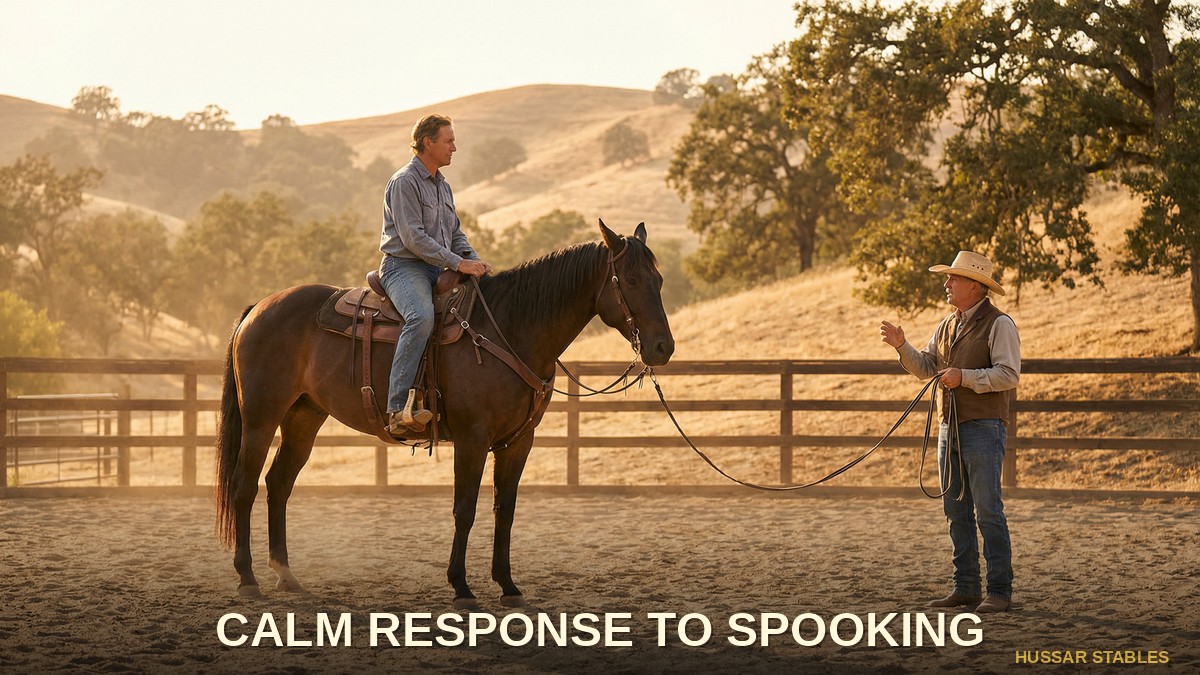
Spooking is normal horse behavior. Panicking is the rider's choice. Here is how to stay safe, stay calm, and actually help your horse when it spooks.
When a horse spooks, the most important thing is to stay calm and keep your seat. Sit deep, look where you want to go (not at the scary object), apply steady leg pressure, and use a one-rein stop if the horse bolts. Panicking, gripping with your legs, or pulling on both reins simultaneously will make the situation worse.
Horses are prey animals. Their survival instinct is to flee from anything that looks, sounds, or smells threatening. This means that at some point in your riding career, your horse is going to spook.
It might be a plastic bag. It might be a dog. It might be a shadow that was not there yesterday. Horses are creative in what frightens them.
What happens next depends almost entirely on you.
Understanding Why Horses Spook
Before we talk about what to do, it helps to understand what is happening in your horse's brain.
A horse's nervous system is wired for survival. When it perceives a threat — real or imagined — it triggers a flight response: a sudden jump, spin, or bolt away from the scary object. This is not disobedience. It is not aggression. It is biology.
The horse is not trying to unseat you. It is trying to survive what it perceives as a threat. Your job as the rider is to help it understand that the threat is not real — and to do that, you need to stay calm.
The Rider's Response: What Works and What Does Not
What does not work:
- Gripping with your legs (this signals "go faster" to the horse)
- Pulling on both reins simultaneously (this creates a tug-of-war that escalates tension)
- Shouting or making sudden movements (this confirms to the horse that something is wrong)
- Looking at the scary object (your body turns toward it, which turns the horse toward it)
What works:
- Sitting deep and relaxing your hips (this signals calm to the horse through your seat)
- Looking away from the scary object, toward where you want to go
- Applying steady, even leg pressure (not gripping — steady pressure)
- Using your voice calmly ("easy," "whoa," "good boy")
- If the horse bolts: the one-rein stop
The One-Rein Stop
The one-rein stop is the most important emergency technique for a bolting horse. It works by disengaging the horse's hindquarters, which breaks the forward momentum without creating the resistance of a two-rein pull.
How to perform a one-rein stop:
1. Slide one hand down the rein toward the bit
2. Bring that hand toward your hip on the same side — not across your body
3. This bends the horse's head toward your knee, causing the hindquarters to disengage
4. The horse will slow and stop as it loses its ability to push forward with both hind legs
Practice this at the walk and trot before you need it at speed. At Hussar Stables, we teach the one-rein stop in the first few months of the program.
After the Spook
Once the horse has settled, the worst thing you can do is immediately retreat from the scary object. This confirms to the horse that the object was, in fact, dangerous.
Instead, give the horse a moment to settle, then calmly ask it to approach the object at its own pace. Let it sniff, look, and investigate. Reward calm behavior with a quiet voice and a pat.
This is called "sacking out" or desensitization, and it is one of the most valuable things you can do to reduce the frequency of future spooks.
Building a Spook-Proof Partnership
The best long-term solution to spooking is not to find a horse that never spooks — those horses do not exist. It is to build a partnership with your horse based on trust, clear communication, and consistent training.
At Hussar Stables, our horses are regularly exposed to a wide variety of stimuli — tarps, flags, umbrellas, balls, and more — as part of our ongoing desensitization program. Our lesson horses are among the most reliable in the Antelope Valley precisely because of this work.
Ready to build that partnership? Book an Intro Lesson and experience the Hussar Stables approach to safe, confident riding.
- A spook is a normal flight response — it is not aggression or disobedience
- Sit deep and look away from the scary object — where you look, the horse tends to go
- Steady leg pressure (not gripping) helps the horse feel supported rather than more alarmed
- The one-rein stop is the most effective way to stop a bolting horse safely
- Desensitization training reduces the frequency and intensity of spooks over time
Have a question?
Text us — we reply fast.
(661) 227-3214 · Hussar Stables, Palmdale CA
Ready to Experience This in Person?
Book a private Intro Lesson at Hussar Stables and discover why families from Palmdale, Lancaster, and Santa Clarita choose our members-only riding club.
Book Intro Lesson