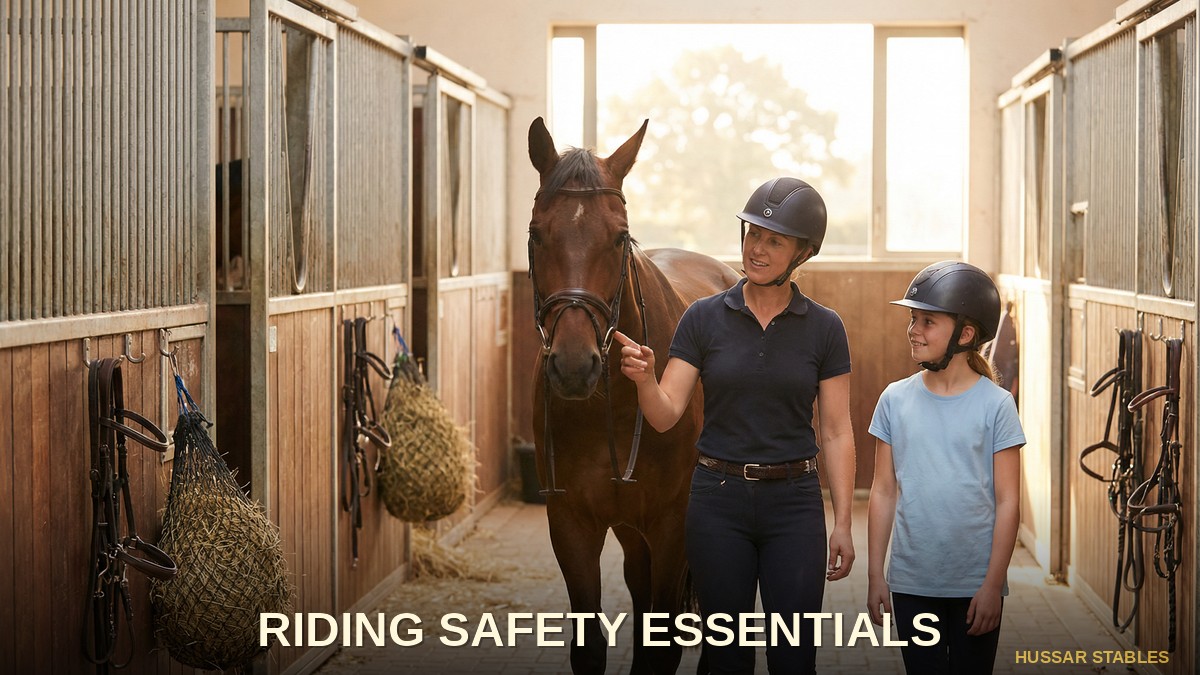
Before you get on a horse for the first time, there are 10 safety rules that could prevent the most common riding accidents. Every beginner needs to know these before their first lesson.
The 10 most important horseback riding safety rules for beginners are: (1) always wear a certified helmet, (2) wear boots with a heel, (3) never walk behind a horse without warning, (4) approach from the shoulder, (5) never run in the barn, (6) keep your feet in the stirrups correctly, (7) know how to stop before you go, (8) always tell someone where you are riding, (9) never tie a horse by the reins, and (10) trust your instructor.
Before you get on a horse for the first time, there are a handful of safety rules that every beginner — and every parent of a beginner — needs to know. These are not arbitrary rules. Each one exists because someone was hurt when it was not followed.
Rule 1: Always Wear a Certified Helmet
This is non-negotiable. An ASTM/SEI-certified equestrian helmet must be worn every time you are on a horse. Not a bicycle helmet. Not a skateboard helmet. An equestrian helmet, certified for riding.
At Hussar Stables, we provide certified helmets for every Intro Lesson. Once you join a program, we strongly recommend purchasing your own fitted helmet.
Rule 2: Wear Boots With a Heel
The heel on a riding boot is not decorative. It prevents your foot from sliding through the stirrup — a scenario that can result in a rider being dragged if they fall. Any boot with a smooth sole and at least a 1-inch heel is acceptable. Sneakers are not.
Rule 3: Never Walk Directly Behind a Horse
A horse's kick can cause serious injury. When moving around a horse's hindquarters, either pass well out of kicking range (at least 10 feet) or place your hand on the horse's hindquarters as you pass, so it knows where you are.
Rule 4: Approach From the Shoulder
Always approach a horse from the front-left (near side), at the shoulder. Never approach directly from the front (horses have a blind spot directly in front of their nose) or from behind. Speak to the horse as you approach so it knows you are coming.
Rule 5: Never Run in the Barn
Running, shouting, and sudden movements in the barn create dangerous situations. Horses are prey animals — sudden movements trigger flight responses. Walk calmly, speak quietly, and move deliberately around horses at all times.
Rule 6: Keep Your Feet in the Stirrups Correctly
The ball of your foot — not the arch or the toe — should rest on the stirrup iron. Your heel should be pressed down. This position keeps your foot from sliding through the stirrup and gives you the most secure, balanced seat.
Rule 7: Know How to Stop Before You Go
Before your horse moves faster than a walk, you should know how to stop it. This sounds obvious, but many beginners focus entirely on "go" and forget about "whoa." At Hussar Stables, we teach halt before we teach walk, and we teach walk before we teach trot.
Rule 8: Never Tie a Horse by the Reins
If a tied horse pulls back and the reins break, the horse can injure its mouth and bolt. Always use a proper lead rope and a quick-release knot when tying a horse. Reins are for riding, not tying.
Rule 9: Always Tell Someone Where You Are Riding
If you are riding on trails or outside an arena, always tell someone where you are going and when you expect to return. Carry a phone if possible. This is especially important for solo riders.
Rule 10: Trust Your Instructor
Your instructor's job is to keep you safe and help you progress. If they tell you to stop, slow down, or get off — do it without argument. If something feels wrong, say so. Good communication between rider and instructor is one of the most important safety tools available.
---
At Hussar Stables, safety is not an afterthought — it is built into every aspect of our program, from the selection of our lesson horses to the structure of our curriculum. Book an Intro Lesson and see our safety standards in person.
- A certified equestrian helmet and boots with a heel are non-negotiable before mounting
- Always approach a horse from the shoulder — never directly from the front or rear
- Never walk directly behind a horse without first placing a hand on its hindquarters to announce your presence
- Know how to perform an emergency stop before you ride at any speed above a walk
- The barn is not a playground — running, shouting, and sudden movements around horses create dangerous situations
Have a question?
Text us — we reply fast.
(661) 227-3214 · Hussar Stables, Palmdale CA
Ready to Experience This in Person?
Book a private Intro Lesson at Hussar Stables and discover why families from Palmdale, Lancaster, and Santa Clarita choose our members-only riding club.
Book Intro Lesson