Horseback riding does carry risks. But with the right program, the right equipment, and the right horses, it is one of the safest sports your child can pursue. Here is what the data actually says.
Horseback riding carries real risks — it is classified as a high-risk sport by some medical organizations. However, the risk profile changes dramatically based on the quality of the program, the training of the lesson horses, and the use of proper safety equipment. In a structured program with certified instructors and well-trained horses, the injury rate is comparable to soccer and gymnastics.
Every parent who considers enrolling their child in riding lessons asks the same question: is this safe?
It is the right question to ask. And it deserves an honest answer — not a reassuring brush-off.
The Honest Risk Profile
Horseback riding is classified as a high-risk sport by the American Medical Association and the British Medical Association. Falls happen. Horses are large, powerful animals with their own instincts and reactions. Anyone who tells you riding is completely safe is not being truthful.
However, the risk profile of riding varies enormously based on three factors:
1. The quality and training of the lesson horse
2. The structure and safety protocols of the program
3. The use of proper safety equipment
When all three factors are optimized, the injury rate for structured riding programs is comparable to soccer, gymnastics, and other mainstream youth sports.
The #1 Safety Factor: The Lesson Horse
This is the factor most parents do not think about — and it is the most important one.
A well-trained, experienced lesson horse that has been specifically selected and conditioned for beginners is dramatically safer than a horse that has not. Lesson horses at reputable programs are:
- Desensitized to sudden movements, loud noises, and unpredictable rider behavior
- Trained to stop when a rider loses balance or falls
- Evaluated regularly for soundness and temperament
- Matched to the appropriate level of rider
At Hussar Stables, every lesson horse undergoes a rigorous evaluation before being used with students. We retire horses from the lesson program the moment we have any concern about their suitability. Our horses are our most important safety asset.
The #2 Safety Factor: Proper Equipment
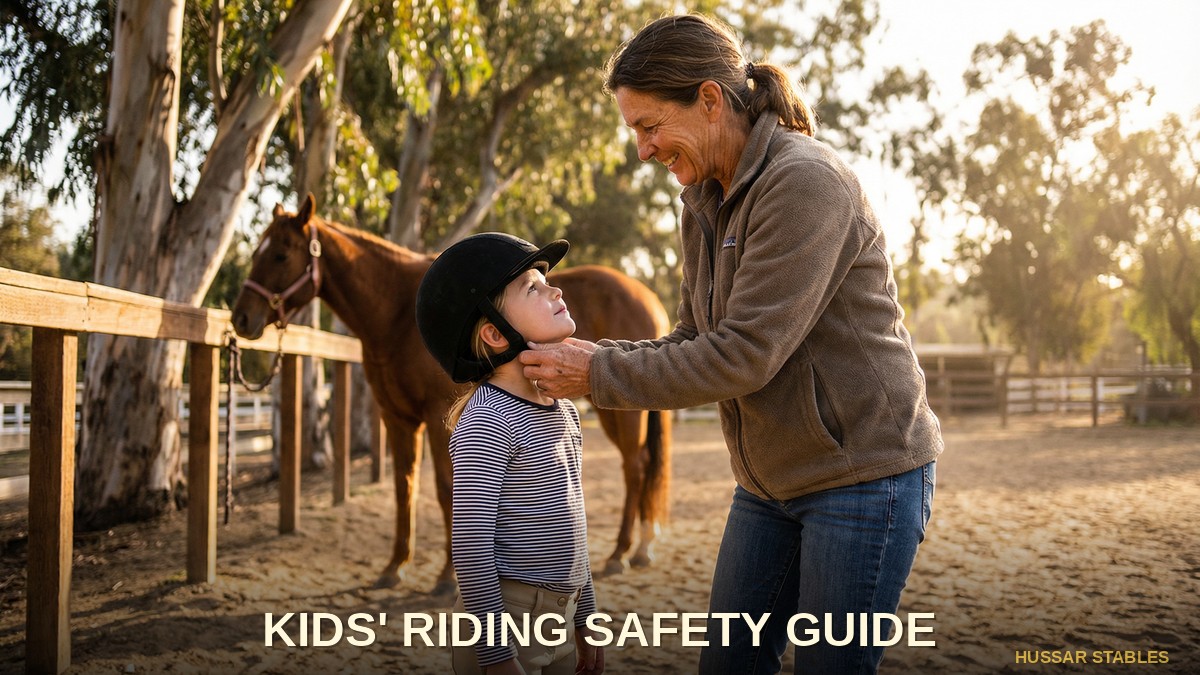
An ASTM/SEI-certified equestrian helmet is non-negotiable. Research consistently shows that certified helmets reduce the risk of serious head injury by over 70% in falls.
Important: a bicycle helmet is not an equestrian helmet. They are designed for different impact profiles. A bicycle helmet will not protect your child in a riding fall.
Boots with a 1-inch heel are the second critical piece of equipment. The heel prevents the foot from sliding through the stirrup — a scenario that can result in a rider being dragged if they fall.
At Hussar Stables, we provide certified helmets and appropriate boots for every Intro Lesson at no charge.
The #3 Safety Factor: Program Structure
Unstructured barns — where students are put on horses with minimal supervision and little curriculum — have significantly higher injury rates than structured programs. The reasons are straightforward:
- Instructor-to-rider ratio: A single instructor managing eight beginners cannot monitor everyone simultaneously. At Hussar Stables, we maintain a maximum of 4 riders per instructor.
- Defined safety protocols: Every lesson at Hussar Stables follows a defined safety protocol — mounting procedure, arena rules, emergency dismount training, and post-lesson horse care.
- Progression system: Riders are not advanced to new skills until they have demonstrated competency at the current level. No child is put in a canter before they have a secure seat at the trot.
Teaching Body Language: The Underrated Safety Tool
One of the most effective safety interventions available is also one of the least discussed: teaching children to read horse body language.
A horse communicates its emotional state clearly — pinned ears, swishing tail, tense muscles, and wide eyes are all warning signs. Children who learn to read these signals can avoid situations that lead to accidents. This is why every Hussar Stables membership includes unmounted horsemanship education alongside riding lessons.
The Bottom Line
Is horseback riding safe for kids? In the right program, with the right horses and the right equipment: yes, it is a safe and enormously rewarding sport. In the wrong program — an unstructured barn with poorly trained horses and no safety protocols — it carries real risk.
The most important thing you can do as a parent is choose the right program. Visit the barn. Watch a lesson. Ask about the horses. Ask about the instructor's credentials. Ask about the safety protocols.
At Hussar Stables, we welcome every one of those questions. Book an Intro Lesson and see our safety standards in person.
- The single biggest safety factor is the quality and training of the lesson horse — not the rider's skill
- An ASTM/SEI-certified helmet reduces the risk of serious head injury by over 70%
- Small class sizes (1-4 riders) allow instructors to monitor and prevent unsafe situations in real time
- Structured programs with defined safety protocols have dramatically lower injury rates than unstructured barns
- Teaching children to read horse body language is one of the most effective safety interventions available
Have a question?
Text us — we reply fast.
(661) 227-3214 · Hussar Stables, Palmdale CA
Ready to Experience This in Person?
Book a private Intro Lesson at Hussar Stables and discover why families from Palmdale, Lancaster, and Santa Clarita choose our members-only riding club.
Book Intro Lesson