Ask ten riders to define the half-halt and you will get ten different answers. Here is the clearest explanation of what it actually is, why it works, and how to develop it in your own riding.
# The Half-Halt: What It Is, Why It Matters, and How to Ride It
Ask ten riders to define the half-halt and you will get ten different answers. Some will say it is a brief squeeze of the rein. Others will say it is a momentary closing of the leg and hand together. Others will describe it as a rebalancing aid, a preparation signal, or a way to ask the horse to wait. All of these descriptions contain partial truth, which is part of why the half-halt is so widely misunderstood.
The half-halt is not a single, discrete action. It is a coordination of aids — seat, leg, and hand working together in a specific sequence — that achieves a specific result: the horse shifts more weight onto its hindquarters, becomes more balanced and attentive, and is prepared for whatever comes next.
Understanding the half-halt is one of the clearest dividing lines between a beginner and a developing rider. Once you understand it, you will use it constantly — before every transition, before every corner, before every lateral movement, before every change of pace. It is the punctuation of riding.
Continue Reading · Riding Technique
Riding Technique: The Complete Guide to Learning and Progressing as an Equestrian
16 min read
What the Half-Halt Actually Does
To understand the half-halt, you need to understand what happens to a horse's balance when it moves forward. As a horse accelerates or loses attention, it tends to shift weight onto its forehand — the front legs carry more of the load, the hindquarters trail out behind, and the horse becomes heavy in the hand and difficult to steer. This is the natural tendency of any moving quadruped, and it is the state that most beginner riders experience as "pulling on the reins" or "the horse is running away with me."
The half-halt reverses this tendency temporarily. By engaging the hindquarters — asking the hind legs to step further under the horse's body and carry more weight — the half-halt shifts the balance rearward. The horse becomes lighter in the front, more responsive to the aids, and more capable of the movement that follows.
Think of it as the equestrian equivalent of a basketball player gathering themselves before a jump — a brief moment of collection and preparation that makes the next action more powerful and precise.
The Sequence of Aids
The half-halt is executed through a specific sequence of aids, typically described as: leg, seat, hand — in that order.
Continue Reading · Riding Technique
Mastering the Bridge: A Step-by-Step Guide to Working Equitation Obstacles
8 min read
Leg first: The leg aid engages the hindquarters. A brief, firm squeeze of both legs (or the inside leg alone, depending on context) asks the horse's hind legs to step under more actively. This is the engine of the half-halt — without the leg, the hand alone simply slows the horse without engaging the hindquarters.
Seat second: As the leg activates the hindquarters, the rider's seat deepens and briefly resists the forward movement. This is not a gripping or clenching — it is a momentary heaviness, as if the rider's weight increases for one stride. The seat acts as a bridge between the driving leg and the restraining hand.
Hand third: The hand closes briefly on the rein — not a pull, but a squeeze, as if squeezing water from a sponge — and then immediately releases. The release is as important as the squeeze. A hand that holds creates resistance and tension; a hand that squeezes and releases invites the horse to carry itself.
The entire sequence happens in less than a second. It is not a dramatic action — an observer watching a skilled rider execute a half-halt will often not see it at all. What they will see is the horse's response: a slight rounding of the back, a stepping under of the hindquarters, a lightening of the forehand.
Continue Reading · Riding Technique
How Alta Escuela Principles Build Better Riders (Even if You Never Compete)
7 min read
Common Mistakes
Using only the hand. The most common half-halt mistake is pulling back on the rein without the leg and seat. This slows the horse but does not engage the hindquarters — the horse simply becomes slower and heavier, not more balanced. Always start with the leg.
Not releasing. A half-halt that does not release becomes a full halt, or worse, a constant backward pressure that teaches the horse to lean on the hand. The release is what tells the horse that the message has been received and that it can carry itself.
Too much, too often. A half-halt that is too strong or too frequent loses its meaning. The horse should respond to a subtle aid; if you are using strong aids repeatedly without response, the horse has been desensitized and the underlying training needs to be addressed.
Wrong timing. The half-halt is most effective when applied as the horse's inside hind leg is about to leave the ground — the moment when the hindquarter can most easily be engaged. Developing the feel for this timing takes time and is one of the reasons the half-halt is considered an intermediate skill.
Continue Reading · Riding Technique
Why Unmounted Horsemanship is Just as Important as Riding
6 min read
When to Use the Half-Halt
Once you understand the half-halt, you will find uses for it everywhere:
Before transitions: A half-halt before asking for a trot-to-canter transition prepares the horse's hindquarters to carry the additional weight of the canter depart, resulting in a cleaner, more uphill transition.
Before corners: A half-halt before a corner rebalances the horse and prepares it to bend through the turn without falling onto the forehand.
Before lateral movements: Any lateral movement — leg yield, shoulder-in, travers — requires the horse to be balanced and attentive. A half-halt before the movement sets up the conditions for success.
Continue Reading · Riding Technique
How to Prepare Your Horse for the Working Equitation Speed Trial
8 min read
When the horse gets strong or fast: Rather than pulling back, a half-halt re-engages the hindquarters and rebalances the horse without creating a pulling match.
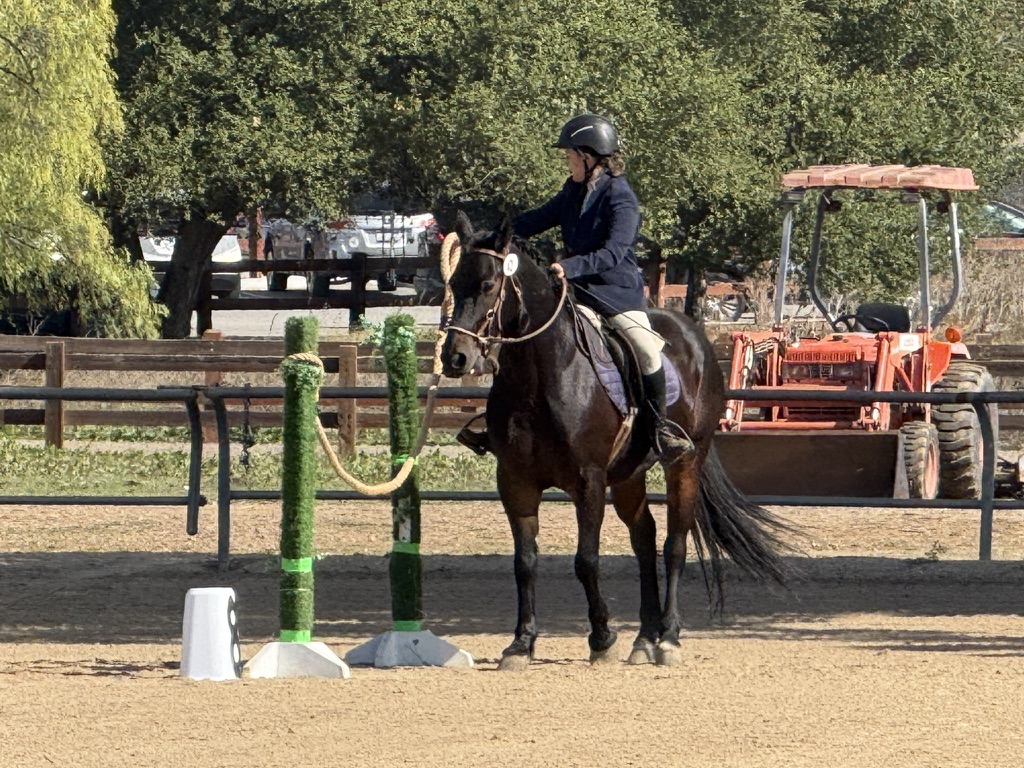
Before obstacles in Working Equitation: A well-timed half-halt before a gate, drum, or corridor of poles ensures the horse arrives balanced and responsive, making the obstacle execution cleaner and the score higher.
Developing the Half-Halt
The half-halt is not something you learn once and then have. It is a skill that develops over years of riding, becoming more subtle, more precise, and more effective as the rider's feel and timing improve.
The fastest path to a functional half-halt is work with a qualified instructor who can feel when you are using it correctly and give immediate feedback. Lunge lessons, where the instructor controls the horse's pace and the rider focuses entirely on the aids, are particularly effective.
In the Hussar Stables curriculum, the half-halt is introduced at Level 4 and refined through every subsequent level. By Level 7, members are expected to use the half-halt fluently before every transition and lateral movement — not as a conscious thought, but as a natural part of their riding vocabulary.
---
At Hussar Stables in Palmdale, CA, we teach the half-halt as part of a structured progression that builds the seat, leg, and hand coordination the aid requires. If you are ready to move beyond basic riding and develop the skills that make everything else possible, we invite you to book an Intro Lesson.
[Book an Intro Lesson](/book) at Hussar Stables and begin developing the aids that define a true horseman.
More in Riding Technique
Riding Technique: The Complete Guide to Learning and Progressing as an Equestrian
16 min read
Mastering the Bridge: A Step-by-Step Guide to Working Equitation Obstacles
8 min read
How Alta Escuela Principles Build Better Riders (Even if You Never Compete)
7 min read
Why Unmounted Horsemanship is Just as Important as Riding
6 min read
How to Prepare Your Horse for the Working Equitation Speed Trial
8 min read
Classical vs. Modern Dressage: What Every Rider Should Know
5 min read
Have a question?
Text us — we reply fast.
(661) 227-3214 · Hussar Stables, Palmdale CA
Ready to Experience This in Person?
Book a private Intro Lesson at Hussar Stables and discover why families from Palmdale, Lancaster, and Santa Clarita choose our members-only riding club.
Book Intro Lesson