The corridor of poles looks simple — ride straight through a channel of poles on the ground. What it actually tests is the quality of your horse's straightness, the steadiness of your rhythm, and the precision of your line. Here is how to ride it well.
# The Working Equitation Corridor of Poles: Straightness, Rhythm, and Precision
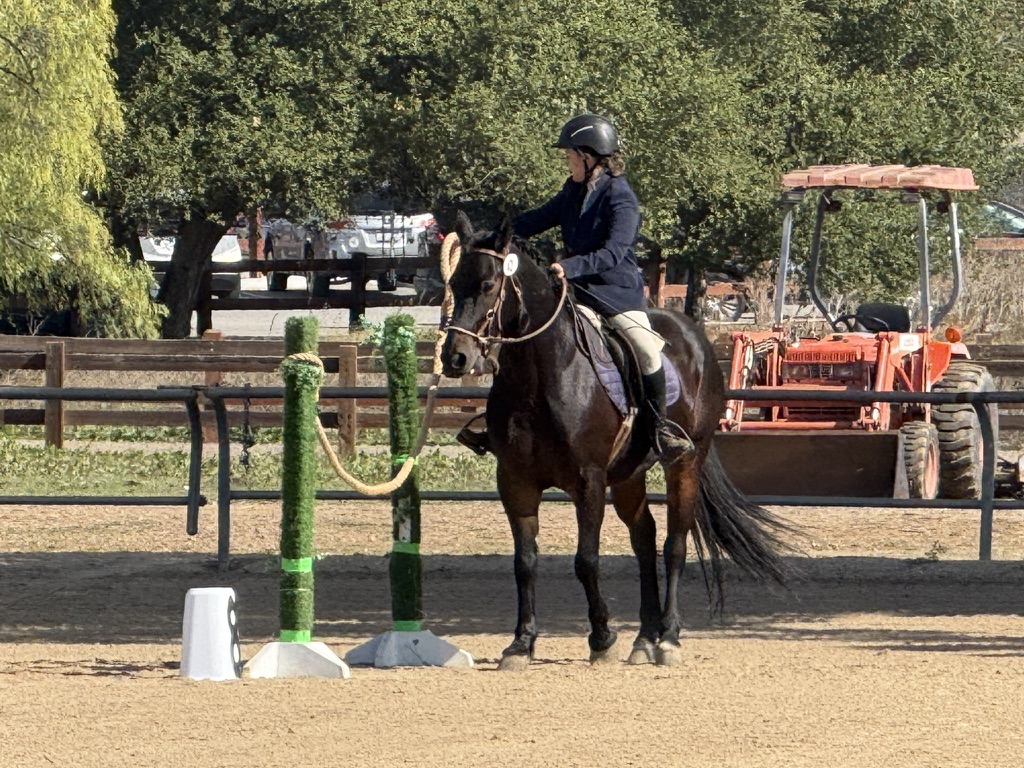
Among the Working Equitation ease-of-handling obstacles, the corridor of poles is the one that most exposes the quality of everyday riding. There is no gate to open, no bell to ring, no object to pick up. The task is simply to ride a straight line through a narrow channel of poles laid on the ground, in a steady rhythm, without disturbing a single pole.
It sounds easy. It is not.
The corridor of poles is a direct test of three things that underpin all classical riding: the horse's straightness, the rider's ability to maintain a consistent rhythm, and the precision of the line. A horse that drifts, rushes, or falls out through the shoulder will knock poles. A rider who over-corrects, loses rhythm at the entrance, or allows the horse to speed up through the channel will knock poles. The obstacle rewards quiet, accurate riding and penalizes everything else.
Continue Reading · Working Equitation
Complete Guide to Working Equitation: Everything You Need to Know
18 min read
What the Corridor of Poles Involves
In competition, the corridor of poles consists of a series of poles laid on the ground in two parallel lines, forming a channel approximately 1.5 to 2 meters wide and 8 to 12 meters long (dimensions vary by competition level and rulebook). The horse and rider must enter the corridor at a designated gait — typically trot at lower levels, canter at higher levels — travel the full length of the channel without touching any poles, and exit at the designated gait.
At higher competition levels, the corridor may be combined with a halt in the middle, a rein-back, or a transition within the channel — adding layers of difficulty to what is already a precision task.
Why Straightness Is the Core Challenge
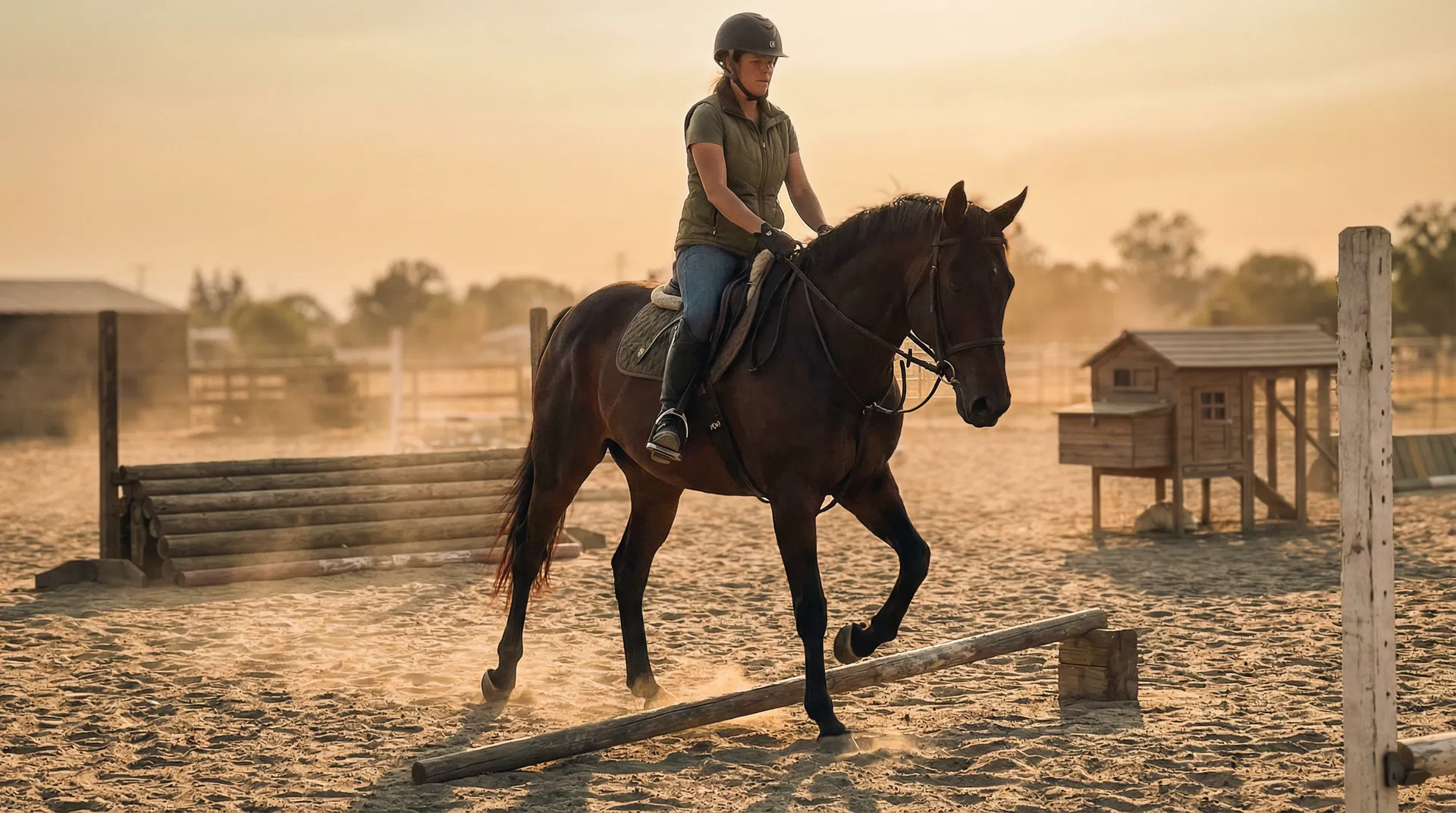
A horse that is truly straight — meaning its hind feet track directly in the footprints of its front feet, and its spine is aligned with the line of travel — will naturally stay in the center of the corridor without the rider making constant corrections. A horse that is crooked will drift toward one side, requiring the rider to correct, which often causes overcorrection toward the other side, which requires another correction, and so on until a pole is disturbed.
Most horses are not naturally straight. They have a preferred bend, a tendency to fall out through one shoulder, and habitual crookedness that the rider must learn to feel and address. The corridor of poles makes this crookedness visible in a way that open-field riding does not.
Continue Reading · Working Equitation
What is Working Equitation? A Beginner's Guide to the USA's Fastest-Growing Equestrian Sport
9 min read
Training straightness is a long-term project that involves work on both reins, exercises that develop equal engagement of both hind legs, and the rider's ability to feel and correct asymmetry before it becomes visible. The corridor of poles is both a test of this work and a training tool for developing it.
Riding the Corridor: Approach, Channel, Exit
The Approach
The approach to the corridor of poles is where the obstacle is won or lost. You need to arrive at the entrance on a straight line, perpendicular to the poles, at the correct gait and rhythm. An approach that arrives at an angle will put the horse's body across the channel before the first stride is taken, making a clean exit almost impossible.
Plan your approach from at least 15 meters out. Identify the center of the entrance and ride to it as if it were the center of a letter in a dressage test. Establish your rhythm before the entrance — do not try to adjust pace once you are in the channel.
Inside the Channel
Once inside the corridor, resist the urge to look down at the poles. Looking down drops your weight forward, collapses your chest, and disrupts the balance that keeps the horse straight. Instead, look through the exit — fix your eyes on a point beyond the far end of the channel and ride toward it.
Continue Reading · Working Equitation
Working Equitation vs. Dressage: Understanding the Key Differences
8 min read
Keep your aids quiet. Small, frequent corrections are more disruptive than one clear correction followed by stillness. If the horse drifts left, a single clear leg aid from the left leg (not a kick — a firm, steady pressure) is more effective than a series of taps. After the correction, return to stillness and let the horse find the line.
Maintain your rhythm. The most common error inside the channel is allowing the horse to slow down or speed up in response to the visual pressure of the poles. Ride the rhythm you established on the approach and do not let it change.
The Exit
Exit the channel on the same straight line you entered. Do not turn before the last pole is behind you — this causes the hindquarters to swing and the last pole to be disturbed. Ride straight through the exit for at least two horse lengths before making any turn.
Training the Corridor at Home
The corridor of poles is one of the easiest obstacles to set up at home. You need six to eight poles (or cavaletti with the poles on the ground) and approximately 15 meters of flat space.
Continue Reading · Working Equitation
The Essential Gear Guide for Working Equitation Beginners
7 min read
Phase 1: Walk through a wide corridor. Set the poles 3 meters apart — much wider than competition width — and walk through at a relaxed, rhythmic walk. Focus on straightness and rhythm, not on the poles themselves.
Phase 2: Narrow the corridor progressively. Over multiple sessions, reduce the width of the corridor by 20 centimeters at a time, down to competition width (approximately 1.5 meters). Only narrow the corridor when the horse is consistently clean at the current width.
Phase 3: Introduce trot. Once the horse is clean at walk through the competition-width corridor, introduce trot. Start with a wider corridor and narrow progressively as before.
Phase 4: Add transitions. Practice halting in the middle of the corridor and standing quietly before continuing. Then practice a rein-back in the middle. These add the complexity required at higher competition levels.
Continue Reading · Working Equitation
How to Choose the Right Horse Breed for Working Equitation
7 min read
Phase 5: Canter. Introduce canter through the corridor only after the horse is confirmed at trot. The canter requires a larger turning radius on the approach, so plan your line from further out.
Common Mistakes and How to Fix Them
| Mistake | Cause | Fix |
|---|---|---|
| Drifting to one side | Horse's natural crookedness | Address straightness in flat work; use corridor as diagnostic tool |
| Knocking poles at entrance | Angled approach | Plan approach from 15+ meters; ride to center of entrance |
| Horse rushes through | Rider tension; visual pressure of poles | Establish rhythm before entrance; look through exit, not at poles |
| Horse slows or stops | Overly cautious horse; poles too close together | Widen corridor; build confidence at walk before trot |
| Overcorrecting inside channel | Rider reacting to each drift | Make one clear correction; return to stillness; trust the horse |
| Last pole disturbed | Turning before exit | Ride straight through exit for two horse lengths before turning |
How the Corridor Is Judged
Judges evaluate the corridor on the quality of the gaits (rhythm, impulsion, suppleness), the horse's obedience and calmness, the accuracy of the line, and the rider's position and effectiveness of aids. A clean pass through the corridor at a rhythmic, forward trot will score well. Poles disturbed, rhythm lost, or excessive rider correction will reduce the score.
In the speed phase, the corridor must be ridden at pace without sacrificing accuracy. A horse that has been trained to maintain straightness and rhythm through the corridor will be faster through it than a horse that drifts and requires correction — because corrections cost time.
---
At Hussar Stables in Palmdale, CA, the corridor of poles is introduced in the Working Equitation curriculum at Level 4, alongside other precision obstacles that develop the horse's straightness and the rider's accuracy. If you are preparing for competition or simply want to improve the quality of your everyday riding, the corridor of poles is one of the most valuable training tools available.
[Book an Intro Lesson](/book) at Hussar Stables and begin building the precision that Working Equitation demands.
More in Working Equitation
Complete Guide to Working Equitation: Everything You Need to Know
18 min read
What is Working Equitation? A Beginner's Guide to the USA's Fastest-Growing Equestrian Sport
9 min read
Working Equitation vs. Dressage: Understanding the Key Differences
8 min read
The Essential Gear Guide for Working Equitation Beginners
7 min read
How to Choose the Right Horse Breed for Working Equitation
7 min read
Working Equitation Scoring Explained: How Judges Evaluate Your Ride
8 min read
Have a question?
Text us — we reply fast.
(661) 227-3214 · Hussar Stables, Palmdale CA
Ready to Experience This in Person?
Book a private Intro Lesson at Hussar Stables and discover why families from Palmdale, Lancaster, and Santa Clarita choose our members-only riding club.
Book Intro Lesson